SKILL BUILDING—3
Serenity
Prayer
…..' grant me the
serenity
to accept the things I
cannot change,
the courage to change
the things I can,
and the wisdom to know
the difference'.
Background
My dissatisfied and disenchanted
life ended at 60, when I walked up the steps to DYC on April 2000. Journey of
rediscovery was exciting and enriching. Peeling
off 'masks' of conventional conditioning helped unburden the baggage of
childhood abuse. See…I was able to do
so, emulating openness of teenagers and sensing the 'Power of Proactive
Response'—concept is centered around the word RESPONSIBILITY
or to put it differently RESPONSE—ABILITY.
Response-Ability.
This hyphenated word, meaning 'Ability to Respond', I first heard from Ken McRae, while teaching the Skill, 'Proactivite
Response'. His elaboration made a lot of sense—
We have no control over occurrence of
situations. But each one has the ability
to respond (Verbal/Non-Verbal) to situations always and every time. In fact, we
can do nothing other than respond! As to the quality of response, please read on!
I still cherish the
session as it challenged me to learn more about this innate and
transformational concept. Initial
learning was thru extensive reading of 7 Habits of Highly Effective People by Stephen
Covey.

16 years of interaction with people of all age groups helped fine-tune the concept. This post is based on real life experiences, consciously steering away from academic or intellectual discourse.
Our uniqueness with no duplicate on planet earth, 'Ability to Respond' is individual-centric, factoring-in perception on Fundamental Principles of Response.
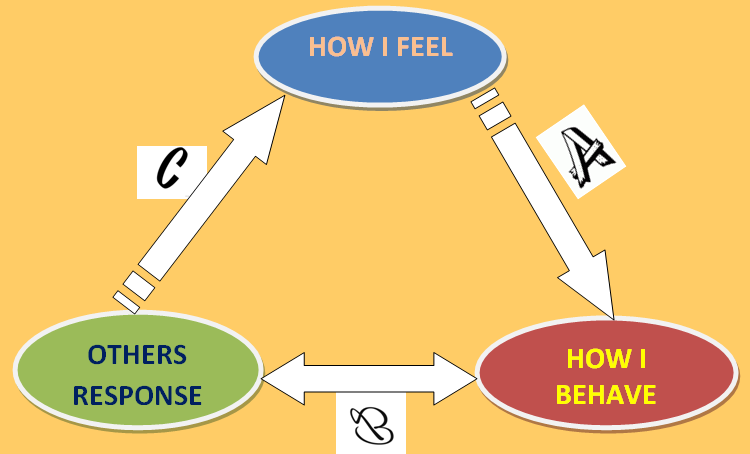
Session on 'Feelings' by Anna & Rich was an
eye-opener. It sensitized me to:
a)
The crucial role of feelings in human behavior and
b)
Significance of Proactive Response to break the Sad Cycle

16 years of interaction with people of all age groups helped fine-tune the concept. This post is based on real life experiences, consciously steering away from academic or intellectual discourse.
Our uniqueness with no duplicate on planet earth, 'Ability to Respond' is individual-centric, factoring-in perception on Fundamental Principles of Response.
Listening to choices of people, in dealing with situations,
continues to enrich me as to the nuances
of Proactive Response. This brings to mind Karen's Story. Proactive Thinking/Response empowered her to
realize after years that she was not a
MASOCHIST. Incredible learning
experience at ground zero!!
Fundamental Principles of Response (FPOR)
1.
Choice of Response. 'Between Stimulus and Response
there is a Space. In that Magic-Space (italics mine) is our power to
choose our response'. Man's Search for Meaning by Viktor E. Frankl, 1946 and 7
Habits of Highly Effective People by Stephen R Covey 1989'. Those, who gloss
over the Magic-Space, are sucked into the quicksand of Sad Cycle bruised and battered until they break the Cycle! Practical application of it enabled Dr
Frankl survive "years
of unspeakable horror in Nazi death camps".

Trainee from
Indian Military Academy (IMA), Dehradun carried the burden of childhood sexual abuse until he dealt with it few
days before Graduation Ceremony. He glossed over the Magic Space for nearly 12
years. To read more..
2.
Choices and Consequences. Every choice (Good or Bad) has
short and long term consequences (Positive or Negative) conforming to the Law
of Cause & Effect. To read more... Making choice is like picking up a stick—One end is
Choice and the other Consequences. Wishful thinking to wish away adverse
consequences would only worsen matters!! We could draw lessons from our past
experiences! Few real life instances:
·
Many do not acquire health insurance
despite ill-health warnings. Is it logical to wish away sickness?
·
Most teenagers postpone studies till
last moment and then feel confused and over-stressed
·
Palpable disharmony post most marriages,
suggests wedlock out of wishful thinking
Despite awareness, young lady glossed over to check sexual orientation and later endured trauma before divorcing the 'gay' husband within a year. To read more....
3.
Product of Choices
a)
Contrary to common perception & confusion, we are
products of own choices NOT environment or genes or feelings. Hence endowed
with mind to think freely, we are accountable for our choices too. To read more...
b)
Blaming others, learnt tendency embedded since childhood,
may be convenient but counterproductive. In life as well as legally no one else
can be made responsible or accountable for my choices! Period.
4.
Power of Silence & Non-Verbal
Communication (NVC). Silence does not
mean approval yet the message is clearly communicated, NVC being 93 percent. Proviso—the option should be out of Conscious Choice (I
Choose to Keep Quiet) NOT Compulsion (I Have to Keep Quiet). 'Have-To' mode choices always cause intense emotional
upheavals.
When Dad scolds for failing in exam—I have option to 'shout back' or 'keep
quiet'. Both have consequences. Either
of the two option would be my choice. Hence it is always a 'Choose To' NOT
'Have To' Response. One would always be cool,
when 'Choice To Respond' is based on logical thinking.
5.
Quality of Thinking cum Thought
Impulse. Choices flow out of one's thoughts/thought impulse, quality
of which is dependent upon Healthy Sexuality. To Read more…
a)
To recall the insightful question of a Class 7
student—'if thoughts control action/choices, how to know whether I am doing
Right or Wrong Thinking'?
b)
Since then more emphasis has been on teaching Rights
& Wrongs. To read Values/Principles access
6.
Response Equation: Proactive or
Reactive. Following equations should facilitate better
understanding:
·
Right or Principle-Centered
Thoughts=Logical/Positive-Feelings Based Thinking= Happy Cycle*=Good Choices=Response of Winners known as PROACTIVE RESPONSE
·
Wrong or Unethical Thoughts=Illogical/Negative-Feelings
Based Thinking=Sad Cycle*=Bad Choices= Response of Losers known as REACTIVE
RESPONSE


7.
Consequences
a)
Situation=Happy Cycle= Positive Choices= Positive
Consequences=PROACTIVE Response—Possess Skill to Manage
Negative Feelings; High Self Worth; Cheerful Disposition; Confident; Healthy
Relationship; Winners in Life. High EQ. Empowered Individuals*.

The
stated consequences are perceptible in life style of Proactive
People:
Once Mom of a student walked up and shared something
close to her heart. In her words:—
"Recently I was waiting outside the school
gate to fetch my son. That day I was depressed due to certain incidents at
home. I saw you walking by. You did not see me. Despite sultry weather and pressure of teaching naughty students, you
appeared noticeably calm and composed. Impacted by your composure, I was
inspired to introspect. Made choice to deal with my situation differently
instead of feeling miserable. Thanks Sushant”.
b)
Situation=Sad Cycle= Negative Choices= Negative
Consequences= REACTIVE Response —Not Equipped to Manage
Negative Feelings; Low Self Esteem; Hopelessness; Empty Love Tank; Self Harm;
Addiction; Aggressive attitude; Promiscuous Life; Ailments & STD/HIV;
Failure in Relationships; Mega Losers in Life. Low EQ. Disempowered
Individuals*. *See

As a victim of sexual abuse, my
lustful thoughts were too forceful to resist penetrative sex at 9. Fortunately I did not succeed, but lived with
the guilt for decades until I was able to talk about it!!
8.
Circle of Influence
'Quality of Bonding' depends upon the 'Quality of Friendliness' in inter and intra-personal relationship. 'Friendly
Attitude', laced with ethics, empathy and compassion, creates comfort zone that spontaneously
wins friends and influences people. Life style of proactive people exude that
attitude in abundance
Validation of FPOR
Recalling
own experiences would enable readers to validate relevance of the Eight FPOR.
Disagreements with cogent comments are welcome.
Situation—Response Model
The Question
Preceding post concluded with the crucial question:
IF WE HAVE NO CONTROL OUTSIDE
OUR CIRCLE OF CONTROL AND OVER OCCURRENCE OF SITUATIONS, THEN WHAT DO WE HAVE
CONTROL OVER?
Answer. Response—Ability or Ability to Respond as stated earlier. It could be either REACTIVE or PROACTIVE.
To re-emphasize, choice of response is the only option one can exercise on
occurrence of situation.

All 7 models courtesy Ms Meera Handa
Truism. Life is a journey
of Situations and Choice of
Response. By-product is either Happiness
or Sadness
Why Should I be
Proactive?
This
is a legitimate question that each individual needs to process logically and
draw conclusions based on own perspective. In doing so, activities charted on the 7 Models may
aid find answers to the stated question.
Remote
Control of Life
Reactive
people are controlled by Non-Changeables (NCs). It tantamounts to handing over
the 'Remote Control' to others.
After untimely death
(NCs) of 18 year old son, Mom, arthritic patient, was in extreme grief for over
three years. Her old husband and teenage daughter endured anguish witnessing
her suffer and their own frustrations due to gross neglect. Later while sharing memories with me, she was
regretful of her negative-feelings driven behavior. (Losers' Choice)
Proactive people
seldom part with their Remote Control of Life. Winners' Choice.
After
learning this concept, one rebellious but high calibre Prefect shared—'Just realized
Remote of my Life is in the hands of my Girl Friend. Her cribs & cries, even from outstation, have
been distracting me a lot. Such a stupid
way to lead life. Thanks for the awareness Sushant!'
Conclusion
Pearls of Wisdom. ‘It’s not what happens to you,
but how you react to it that matters’ Epictetus, 55-135 AD, Greek Philosopher; 'Life is 10% of what happens and
90% of how one reacts/responds to it'.
Model of Proactivity is nothing
more or less than the stated 'Pearls of Wisdom' handed down by predecessors. Application of the concept, in context
of real life scenarios, would be discussed in ensuing post(s).
Nature's Design. Human's are designed to be Proactive but
perfectly conditioned from childhood to become Reactive. This too would
be elaborated subsequently.
To Be Contd….